
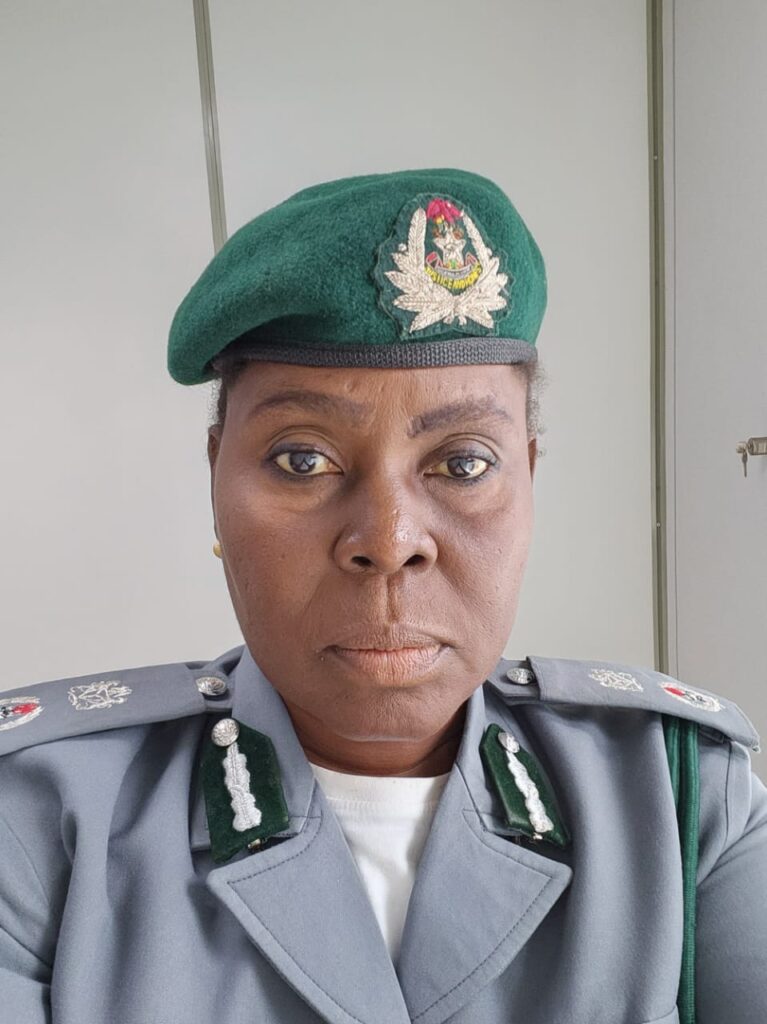
In 1992, Comptroller A Salawu joined the Nigeria Customs. For 33 years, the energetic, cerebral and vibrant officer has continued to wax from strength to strength. She has headed various customs formations at various positions across the country and still moving from glory to glory. As our personality of the week, this senoir customs officer took the editorial team of Upright Communications down memory lane on how her journey started with one of the most government revenue generating agency. She, however thanked God on the decision she made many years ago by joining the Nigeria customs: Excerpts
ABOUT YOU
My name is Comptrroller A. Salawu the current Lagos Industrial Area Command (LIAC) Area Controller; what we do here is we collect excise duties. These are taxes paid on locally manufactured goods. We have about 25 factories under us and some infant industries which we monitor from time to time, to assess their capacities and bring them on board to be licensed as excise factories. So our major function here is to ensure that government revenue is safeguarded and the operations here will facilitate trade based on the federal government policy decree, made in Nigeria goods.
SERVICE HISTORY
I joined the service in 1992 and we did our basic course at the Lagos training college. From there I was posted to Calabar, from there to the Inspectorate and Investigation Headquarters. From there I was taken to ASEKODA at TinCan we were the pioneer officers, I was there for sometime, then went to headquarters, from there back to TinCan then another staff order came that took me to Bauchi. From there I returned to MM Cargo from where I went to Oyo, Osun, later brought back to TinCan. I was promoted to Deputy Comptroller (DC) and was at PTML later went back to headquarters under TNT. When I became substantive Comptrroller, I was posted to ICT and modernisation before this my current posting here at the LIAC.

COMMAND FOCUS
We are in charge of collecting taxes paid on locally manufactured goods, that is what we collect here.LEVEL OF TAX COMPLIANCE We are very lucky in the sense that we have a very interactive stakeholder engagement. We operate an open door policy such that they can call me, they can call the CS, the DC revenue, the PRO, they can even walk in and we will attend to them.We have also tried as much to visit them, observe where they have challenges and encourage them to tell us what we can do to help facilitate their trade and we also organize lectures. They do export here but it was not standardised but when we went round we explained to them the implication of proper documentation and being compliant in export, and they all gladly embraced it.When the Authorized Economic Operator (AEO) started, people focused on the ports forgetting that the factories too import raw materials, packaging and all that, we went round here ourselves to convince them that if you have so and so number of containers, please apply for AEO. Fortunately, some of them were already on fast track 2.0 but the AEO is a better system.
ABOUT AEO
The Authorized Economic Operator (AEO) is for compliant traders. We mean those people that follow due process. When you are a compliant trader, you have some privileges like fast release, delivery, less demurrage, less time, less costs etc. As a compliant trader, once your cargo arrives at the port when you key in, the importer the importer will do what we call self declaration, produce the SDG and go to TinCan or Apapa lodge his entry and once he is a compliant trader, when the cargo comes it does not stay inside the ports, they allow them take delivery immediately to their warehouses. The PCA will go there and if there is any infraction, they give them Demand Notice (DN). The expiration of document paper for declaration in Nigeria is now 10 years it was formerly seven (7). So if you think you have escaped, we can catch you at any time so that’s about the AEO, the condition is that you must be compliant.It has specification for the number of containers that you are bringing, it’s not just one or two containers, we want people that import regularly and have volume.
WHEN YOU TOOK CHARGE OF LIAC COMMAND
I took over on the 8th of September 2025, one ago.
CHALLENGES AT THIS COMMAND
The biggest challenge is the non compliant traders. So many people manufacturing without being licensed. Secondly you have people who shortchange. Secondly my officers take a lot of risk to locate some of these factories and when they see Customs coming, they lock everywhere at times they mobilize people to go and meet them on the way. Luckily for us we have what we call Customs Licensed Agents and we work with them, they give us information and we will do the intelligence together. They go round sighting new factories and they help us bring them on board, because they are the ones who will register them.Another challenge is that we are short of staff. We have made requests and hopefully that will be addressed.
THOUGHTS ON EXCISE DUTY COMPLAINTS BY IMPORTERS
Well they are payments made to generate revenue for the Federal Government. The duty is simply a government policy every year we don’t manufacture them, we implement only the fiscal policy, they are payments made from the ports and excise factories.Secondly those excise duties are not too expensive because there are things the government doesn’t want to come into the country for people to consume; because of their health, they put a levy on them to make it high and discourage people, so the money is not for the customs. Whatever monies we collect we don’t have access to it, if we need anything we will apply to the ministry of finance before we can get any funding.
LAST YEAR REVENUE COMPARED TO PRESENT YEAR
We thank God when I arrived here, the first year was 33 billion plus, then the next year we made 35 billion. We are aiming at 40 billion because our revenue target for this year is 61 billion.
WHAT YOU DID DIFFERENTLY THAT AIDED THE REVENUE GROWTH
One of the reasons for the increase in revenue was because of the B’ogwu and the single unified Customs management service, we were able to block a lot of leakages. When I got here we had issues, all of them were on their own system where as this system faster than their own. So one of the things I did was to send to headquarters ICT to give us specification of the machine they would use. They gave us and we circulated it, the TS and an officer went round and Obinna the sight support officer installed it for them and then we taught them in their factory and also encouraged them to come here to learn. So now we are able to monitor the raw materials, production and finished products, the system can estimate what value has accrued.
We also set up an enforcement unit, they went round to enforce due process in each of the factory while we encouraged them to notify the office when they have any issue like machine breakdown, non productivity, breakdown in supply chain, packaging materials and things like that so we are made aware.Regarding payment, they used to pay at their own time but in the Act, it’s supposed to be 21 days after the previous month. So when I got here, we established the fact that it must not go beyond that date because there is penalty for defaulting and that is 10%. But I’m glad to say that they all comply and pay before the 21st day of the month. So there is no discrepancy in our revenue, what we have here and what they have on board in Abuja at the same time.
DIFFERENCE BETWEEN THIS COMMAND AND MMAC
Well the agents here do not clear anything unlike the other command. Their function here is to identify who is producing what/where they are producing, assess the level of production, and bring the information to us. We now work on it to see which is up to standard to be licensed because there is possibility of future growth and expansion. We will then tell them why they were brought to us, let them know that since they were producing so and so volume, it is not legal without an excise license because there is penalty for that.So once identified, they come here and we explain to them the need to be embedded and the advantages there in. The agent that brought them is the one to now give them the condition for the registration. We would now come with what we call entry of premises from. That is a sort of application that you want to start, you attach your three years Tax Certificate, MOU and Articles of Association, the site plans, the machine line, how many and types of machines. We will go for inspection and then issue provisional approval and forward the copy with all the documents to to the excise headquarters in Abuja where they would issue the the final approval. When it is ready they send it back to us and the agent will then come and sign for it or the the direct company can come and sign for it. However they are trying to automate it and there would be no need to go to Abuja before you renew or register for a license. Also it is important to note that for each product there is a machine line and there’s a license number for the payment of excise duty.
ASSESSMENT OF B’ODOGWU
Before what we operated in the Nigeria Customs Service was MASECODA that was manual system then we moved to ASECODA 2.7, then to 3.0, then to 961 and 962, before we came to this EUCMS an improved version of all those systems. It is very fast, saves cost, time and allows us to monitor people easily.The system is friendly. Now they want to introduce this our system to the whole of Africa, they have studied it. At the last World Customs Day, it was mentioned that they should come and study and implement it. Ghana, Kenya and and all of them will implement it, so the Nigerian Customs Service is on top. NCS was given an award for the best automation by NIPDA.When this B’Odowu was introduced I was controller modernisation, all the MDA’s had to key in and be trained at Abuja. So if you are looking for SON, NAFDAC, every thing is here. That’s why the national single window is built on this. previously there was duplicity which was not too effective, that’s how versatile and efficient the system is. With this B’ODOGWU and the scanning done now, our dwelling time at the ports has reduced.
MESSAGE TO OFFICERS OF LIAR COMMAND
I want them to remain steadfast, do the right things and keep their integrity which is important.
HOW YOU RELAX
Once I leave the office, I leave everything there and go home. On my rest day, I can visit a restaurant or a resort and on Sunday prepare myself for Monday, say my prayers and hope for the best.